By: Haley
When writing, have you ever felt haunted by backstory you need to explain in order to make everything else you want to say make sense to your brilliant reader? BUT the backstory isn’t THE STORY you want to tell so you don’t want to spend too much time talking about it, but you still need to spend at least a little time talking about it because everything else you want to say kinda depends on that context?
Intro
Hi, I’m Haley, English Lit grad here. I’m trying to become a better writer so I’m reading like one and sharing what I find with you. Here’s what I’m learning from Looking for Alaska by John Green. Part Two! If you’d like to watch part one of this series check out the description below.
Life-long learners unite!
Table of Contents
Chapter 1: Writing Constraints
Chapter 2: Bookish books are cool
Chapter 3: Similes of your own creation
Chapter 4: Religion
SPOILERS AHEAD
Chapter One: Writing Constraints
Try setting up a constraint, like listing, and while you’re at it if you’d like to really challenge yourself, try breaking the mold of that constraint with some humor:
“The Colonel explained to me that 1. this was Alaska’s room, and that 2. She had a single room because the girl who was supposed to be her roommate got kicked out at the end of last year, and that 3. Alaska had cigarettes, although the colonel neglected to ask whether 4. I smoke, which 5. I didn’t” (Green 14).
In less than 60 words we’re clued into so many different, yet intermingling dynamics:
1. Alaska’s living circumstances. 2. Hints of Alaska’s thriving cigarette selling business 3. Miles’ aversion to smoking. 4. The Colonel’s nicotine dependency 5. Hints of Alaska’s and the Colonel’s friendship, and 6. Miles’ reserved personality i.e., not communicating to Chip (the Colonel) that he doesn’t smoke.
A temporary form-constraint like listing can be an effective way to catch your reader up to the scene in your mind——to bring them in on your imagination quickly (and wittily). But, this listing technique doesn’t only brings you and your reader on the same page(wink wink)——in other words, gives you both a shared context, but it allows you to spend more writing time, and your reader to spend more reading time, with the scenes that paint a fuller or more detailed picture of the story you’ve set out to tell.
Chapter Two: Bookish books are cool
“Her library filled her bookshelves and then overflowed into waist-high stacks of books everywhere, piled haphazardly against the walls. If just one of them moves, I thought, the domino effect could engulf the three of us in an asphyxiating mass of literature” (Green 15).
If you’ve ever been in a reading rut (perhaps you are right now)reading about reading can be a gentle way to ease yourself back into the practice. Personally, I’ve found it has a way of reminding me, “oh yeah, I actually enjoy this. Why have I been avoiding this?”
Moreover, books that celebrate books are fun to read. Speaking for myself, I love reading a book with a character or characters who have daily dedicated reading time. I think it helps me connect with or at least understand these characters just that little bit more.
“Lying in bed and reading felt pleasantly familiar” (24).
“…I spent the morning working on my religion final and went to Alaska’s room in the afternoon. She was reading in bed. ‘Auden,’ she announced. ‘What were his last words?
‘Don’t know. Never heard of him.’
‘Never heard of him? You poor, illiterate boy. Here, read this line.’ I walked over and looked down at her index finger. ‘You shall love your crooked neighbor / With your crooked heart,’ I read aloud. ‘Yeah. That’s pretty good,’ I said” (Green 85).
So if you need to hear, “It’s okay to write a bookish book” here it is: it’s okay to write a bookish book, in fact I encourage it :). I mean, think about it, Looking for Alaska was John Green’s first novel. Perhaps you’re working on your first novel and as you do so you feel the pull to allude to your greatest inspirations (or more crucially, your characters’ greatest literary inspirations).
Chapter 3: Similes of your own creation
You can use your own made-up creations as similes. (Speaking of creations) I created this diagram to emulate the way the water cycle is portrayed. Because much like the water cycle is an endless movement of water on above and below earth, so too is this concept I’m going to share with you—endless (in the way only a book can be).
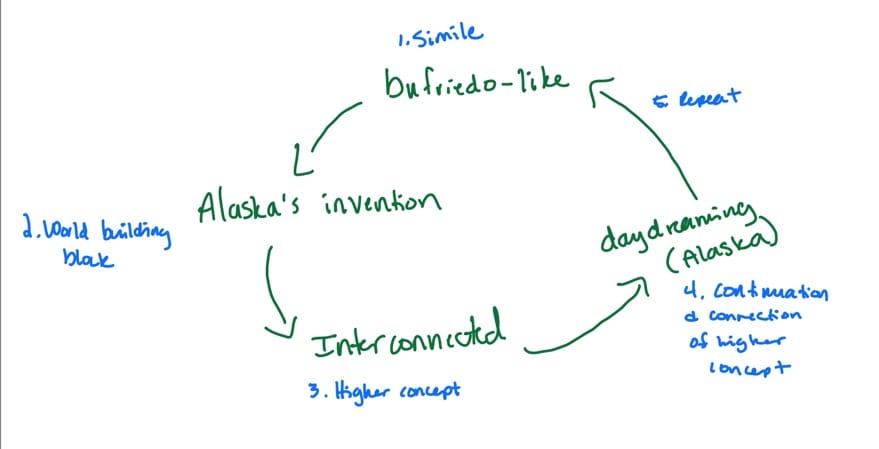
First we see a simile, “bufriedo-like” and we move through parts one and two on the “simile cycle.”
1 & 2. Not only does this phrase evoke an image, but it drags you deeper into the narrator’s world. Alaska invented the verbiage “bufriedo”[1] (very Shakespearean in my opinion)and so I argue we think of her when a bufriedo is mentioned. It’s a Pavlovian bufriedo. Onto part 3 of the “simile cycle.”
Bufriedo = fried burrito
3. “And I listened in class, too, but on that Wednesday morning, when Dr. Hyde started talking about how Buddhists believe that all things are interconnected, I found myself staring out the window” (Green 39).
4. Miles gets in trouble for day-dreaming out the window, Dr. Hyde admonishes him and Alaska defends him. She says,
“I’m sorry but that’s bullshit. You can’t just throw him out of class. You drone on and on for an hour every day, and we’re not allowed to glance out the window?” (Green 39-40).
To think this scene started by invoking the image of a bufriedo.
Something that comes to mind for me when I reflect on this scene, or series of thoughts/events in Miles’ head, is oxygen (a key component of water so I’ve heard). The bufriedo simile and connected scenes breathe in, in steps one and two, convert the oxygen into energy (step 3 and 4), and exhale carbon dioxide, nitrogen, and leftover/unused oxygen (Step 5 and ready to repeat).
A self-sustaining simile like this makes the world the novel exists in (the world the novel designed)feel more real, lived in. Not only has one of the characters invented the “bufriedo” but now the bufriedo functions as a visual for sunburnt students while showcasing Miles’s preference to stay inside studying—un-bufriedoed (although, ironically often eating a bufriedo), and Alaska’s eagerness to stand on her morals.
Behold the duality of bufriedo.
Chapter 4: Religion
A topic I only waded in but didn’t dive into in part one of “Read Like a Writer: Looking for Alaska”).
Pudge and his classmates are studying three world religions throughout the novel(Buddhism, Christianity, and Islam)in Dr. Hyde’s class.
And it was a comment responding to part one of this series that got me thinking. They said:
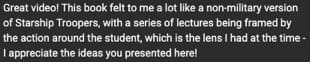
Now, I have yet to read Starship Troopers, (TBR) but nonetheless this comment got me thinking…
“…a series of lectures being framed by the action around the student…” Perhaps part of Dr. Hyde’s function is to frame religion and spirituality for the characters and us the reader, not as something we have to believe in in order to buy into the story, but as a phenomenon worth the time spent learning about. Hyde’s classroom lessons give some extra shape to Miles’ narration. Like:
“…from Hyde’s classroom, things did seem connected” (39).
You’ll recognize this quote from the previous chapter of this video. It’s Hyde’s class that sparks Miles’s wandering imagination. Why did things seem connected from Hyde’s classroom? Yes, partly because of the elevated view, but I would argue more importantly because of the lessons being taught, the ideas being planted, and the eagerness to learn. The familiar structure that a classroom provides offers to take some of the pressure off the reader allowing us to take in the lessons without having to buy into everything being taught in class (because in a way—and even if we are already aware of these concepts——we are learning or relearning alongside these characters within their context).
Perhaps, in your own writing, you want to slowly seep knowledge or information onto your pages without it overtaking your story. Looking for Alaska offers us one way to go about doing that. Cool.
So, to the individual who left that thoughtful comment, thank you, you led me to another layer of understanding and enjoyment with this novel.
Conclusion:
If you’d like to sit a little while longer with these ideas head over to my YouTube channel https://youtube.com/@writerwithacause?si=flhkOLk85Sm-I41n for the video companion to this article.
If you enjoyed this video please consider liking and subscribing so you don’t miss the next one. And if you’d like to support me, head over to my Patreon. It’s just getting started, and I’d love your input on what type of reading and writing content you’d be interested in seeing over there!
I’m excited to meet you in the comments. Let me know what books you’d like me to read like a writer next! Peace.
P.S. I had to add bufriedo to my computer’s dictionary. A happy endeavor.
[1] See page 145 of “Looking for Alaska”
Leave a Reply